How to measure project profitability in a services firm
Revenue, time cost and margin per project, cost rates explained, fixed-fee work done right, and what to do with the answers.
By the LockedHours team · · 3 min read
Most services firms know their overall margin at year end. Far fewer know which projects and clients produced it. The difference matters: a firm can be profitable overall while a third of its projects lose money, subsidized by the rest. With time tracking in place, measuring profitability per project is mostly arithmetic.
The basic calculation
Project profit = revenue − time cost − expenses
Margin = profit ÷ revenue × 100
- Revenue: for hourly work, billable hours × billable rate. For fixed-fee work, the fee (or the part earned so far).
- Time cost: hours worked (billable and non-billable) × each person's cost rate.
- Expenses: costs you incurred for the project, whether or not you re-bill them.
The important detail is the second line: time cost includes all hours on the project, not just billable ones. Non-billable fixes and internal reviews cost you the same as billable work.
Working out cost rates
A cost rate is what an hour of someone's time costs the firm. A simple version: annual salary plus employer taxes and benefits, plus a share of overheads (rent, software, management), divided by the hours they're available to work in a year.
Example. A designer costs $78,000 a year including taxes and benefits, overheads add $18,000 per head, and they're available for 1,760 hours after time off. Cost rate: $96,000 ÷ 1,760 ≈ $55 an hour.
Use the available hours, not just the billable ones, so the cost rate stays stable. Low utilization then shows up where it belongs: as hours with cost and no revenue.
A worked example
| Hourly project | Fixed-fee project | |
|---|---|---|
| Hours worked | 180 h (170 billable) | 260 h |
| Revenue | 170 h × $140 = $23,800 | Fixed fee $30,000 |
| Time cost | 180 h × $58 avg = $10,440 | 260 h × $61 avg = $15,860 |
| Expenses | $600 | $1,900 |
| Profit | $12,760 | $12,240 |
| Margin | 53.6% | 40.8% |
Both projects made similar profit, but the fixed-fee one needed 80 more hours to do it. If the next fixed-fee proposal is priced the same way, the estimate, not the rate, is what needs changing.
Getting fixed-fee projects right
- Track every hour anyway. On a fixed fee the client doesn't see the hours, but your margin depends on them.
- Recognize revenue as the work progresses, for example by phase, if you report profitability before the project ends.
- Compare effective hourly rate: fee ÷ hours worked. In the example, $30,000 ÷ 260 h ≈ $115 an hour, against $140 for hourly work.
What to do with the answers
- Rank clients by margin over the last year. The bottom few are candidates for a price change or a different kind of engagement.
- Compare project types (retainers, fixed fees, hourly). The weakest type usually has an estimating problem.
- Look at hours by task on unprofitable projects. The overrun is usually concentrated in one phase.
- Feed the effective hourly rate back into your next proposal.
Profitability in LockedHours
LockedHours keeps billable and cost rates per person, with history, so every entry carries both. The profitability report shows hours, revenue, time cost, expenses, profit and margin for each project, with fixed-fee and hourly projects side by side, and exports to CSV.
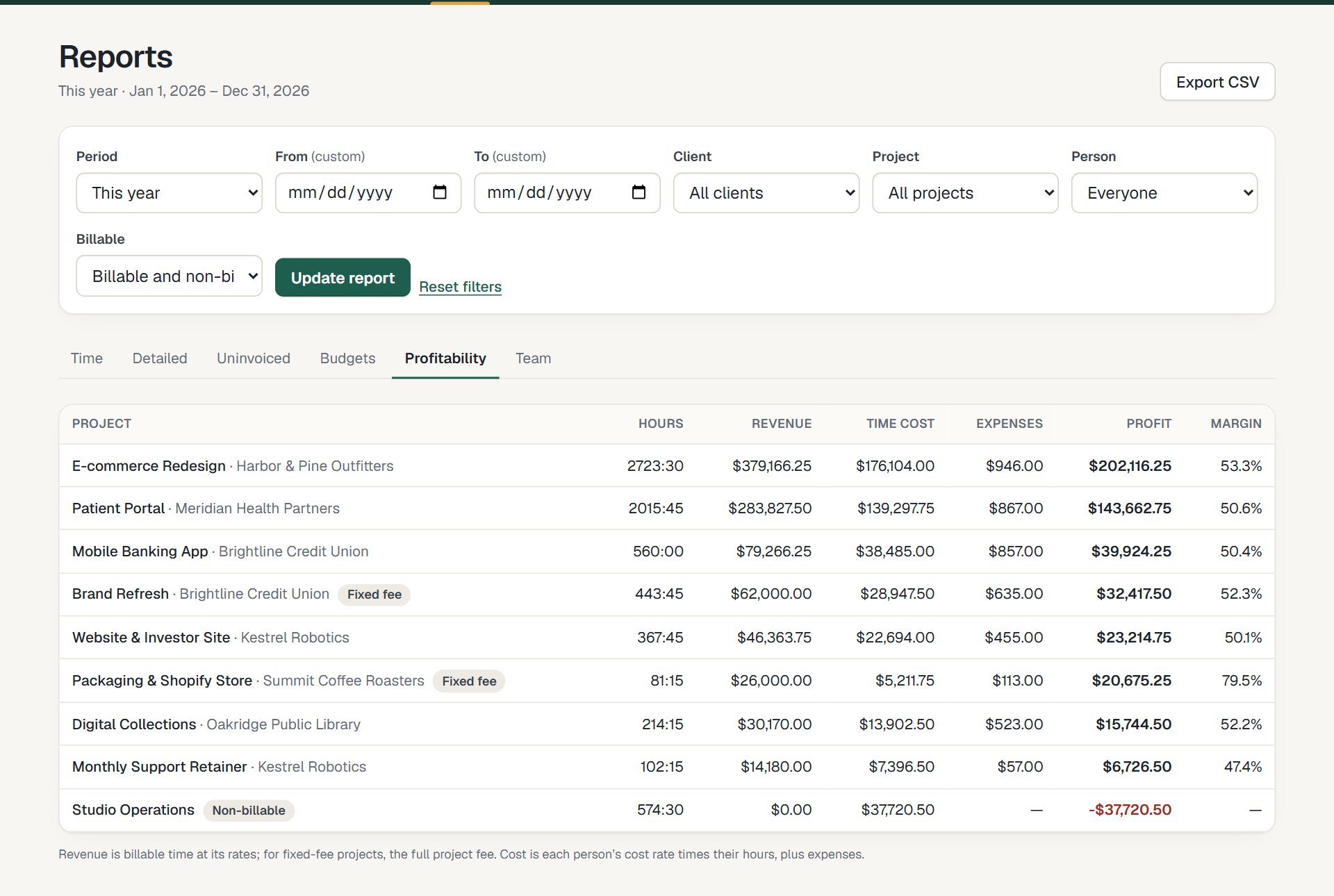
The profitability report: margin per project from your real hours and rates.
See reports and team and rates. To use the same numbers for staffing, read how to calculate utilization rate.
Try it with your own numbers
30 days free, no card. $6 per seat, locked in your contract.