How to price a retainer: a practical guide for agencies
Hours-bank, deliverable and access retainers, pricing from cost and target margin, rollover rules and monthly tracking.
By the LockedHours team · · 3 min read
Retainers give an agency predictable revenue and give a client a team on call. They also quietly lose money more often than any other kind of work, because nobody notices when the hours behind a fixed monthly fee creep up. Pricing a retainer well is mostly about deciding what the client is buying and measuring it every month.
Three retainer models
| Model | The client buys | Main risk |
|---|---|---|
| Hours bank | A number of hours per month, e.g. 40 h | Busy months exceed the cap; quiet months create rollover debt |
| Deliverables | A defined output, e.g. 8 articles and a monthly report | Each deliverable takes longer than estimated |
| Access / advisory | Availability and expertise, not a quantity | Usage grows with no matching price change |
Whichever model you sell, track the time behind it. A deliverables retainer that's priced well in month one can be underwater by month six if each article quietly takes an extra hour.
Price from cost and target margin
Start from what the work costs you, not from your hourly rate times hours:
Monthly price = expected monthly cost ÷ (1 − target margin)
Expected cost = expected hours × cost rate per hour, plus any monthly tools or freelancers.
Example. You expect a content retainer to take 40 hours a month. Your blended cost rate (salary, taxes and overheads per hour) is $55. That's $2,200 of cost. For a 40% margin: $2,200 ÷ 0.60 = $3,667 a month.
Then add what's easy to forget: account management, monthly reporting, and the calls that aren't attached to a deliverable. On many retainers those take a fifth or more of the total time. If you don't estimate them, they come out of your margin.
Unused and extra hours
Decide this before the first invoice, and write it into the agreement:
- Use it or lose it. Simplest for you; clients accept it more easily when the fee is clearly lower than the hourly equivalent.
- Capped rollover. Unused hours carry over for one month only, up to a limit. A common compromise.
- Overage rate. Hours beyond the monthly allowance are billed at an agreed rate, or require approval first.
Unlimited rollover is the option to avoid: it turns quiet months into a growing debt of hours you owe, often due at the busiest moment.
Track every retainer monthly
- Give each retainer its own project with a monthly budget in hours, so each month is measured on its own.
- Get an alert when a month reaches about 80% of its hours, early enough to tell the client before you run out.
- At month end, compare hours used, revenue and cost. Three months over in a row means it's time to re-price.
- Invoice on the same day every month; recurring invoices remove the chance of forgetting.
Our project profitability guide shows how to calculate the margin per retainer from your rates.
Retainers in LockedHours
In LockedHours, a retainer is a project with a monthly budget in hours or fees. Managers get an email when a month crosses the threshold you set, the profitability report shows revenue, cost and margin per project, and recurring invoices send the monthly fee automatically or wait as drafts for you to review.
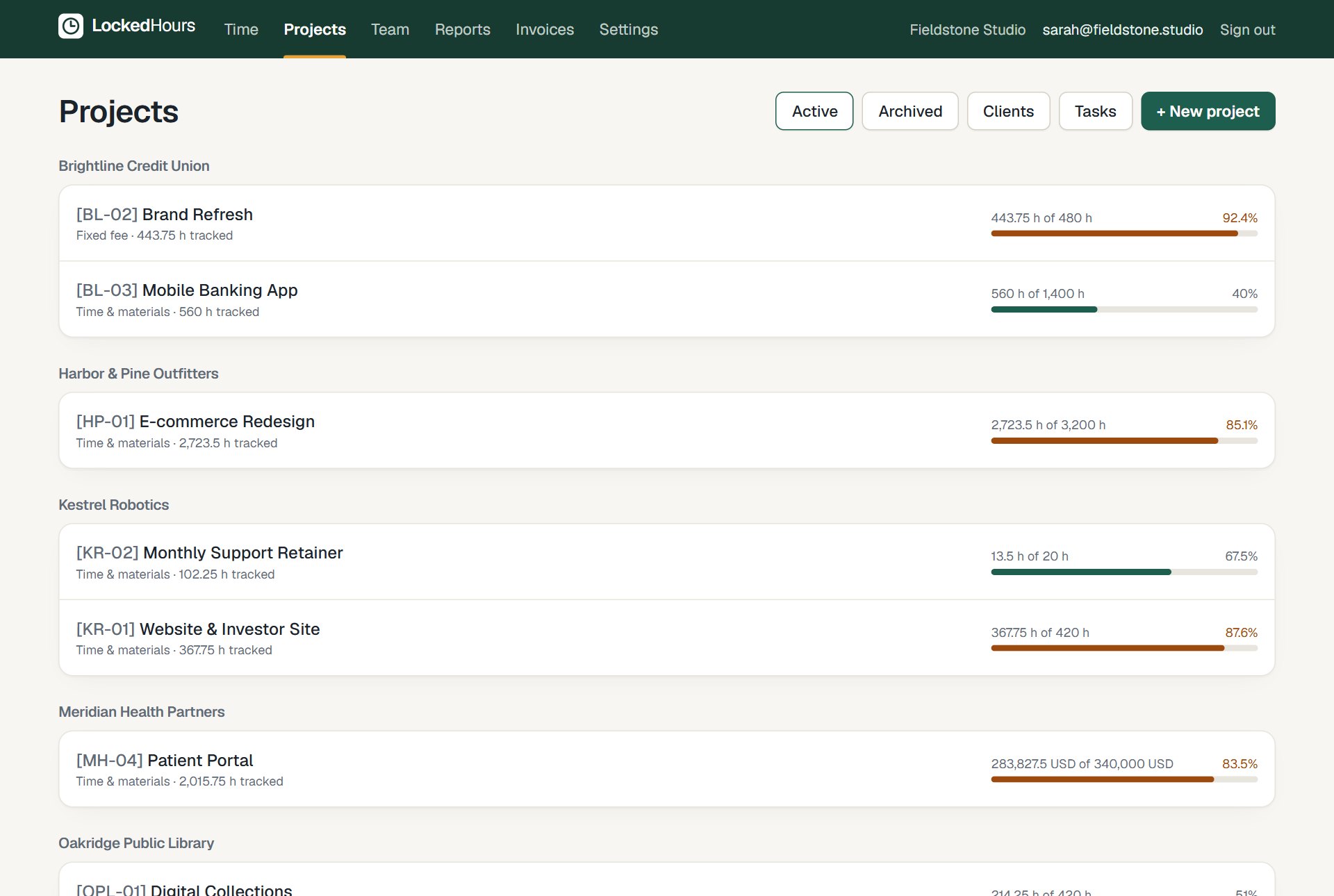
Every project's budget at a glance, retainers included.
See project budgets and invoicing, or how agencies set things up.
Try it with your own numbers
30 days free, no card. $6 per seat, locked in your contract.